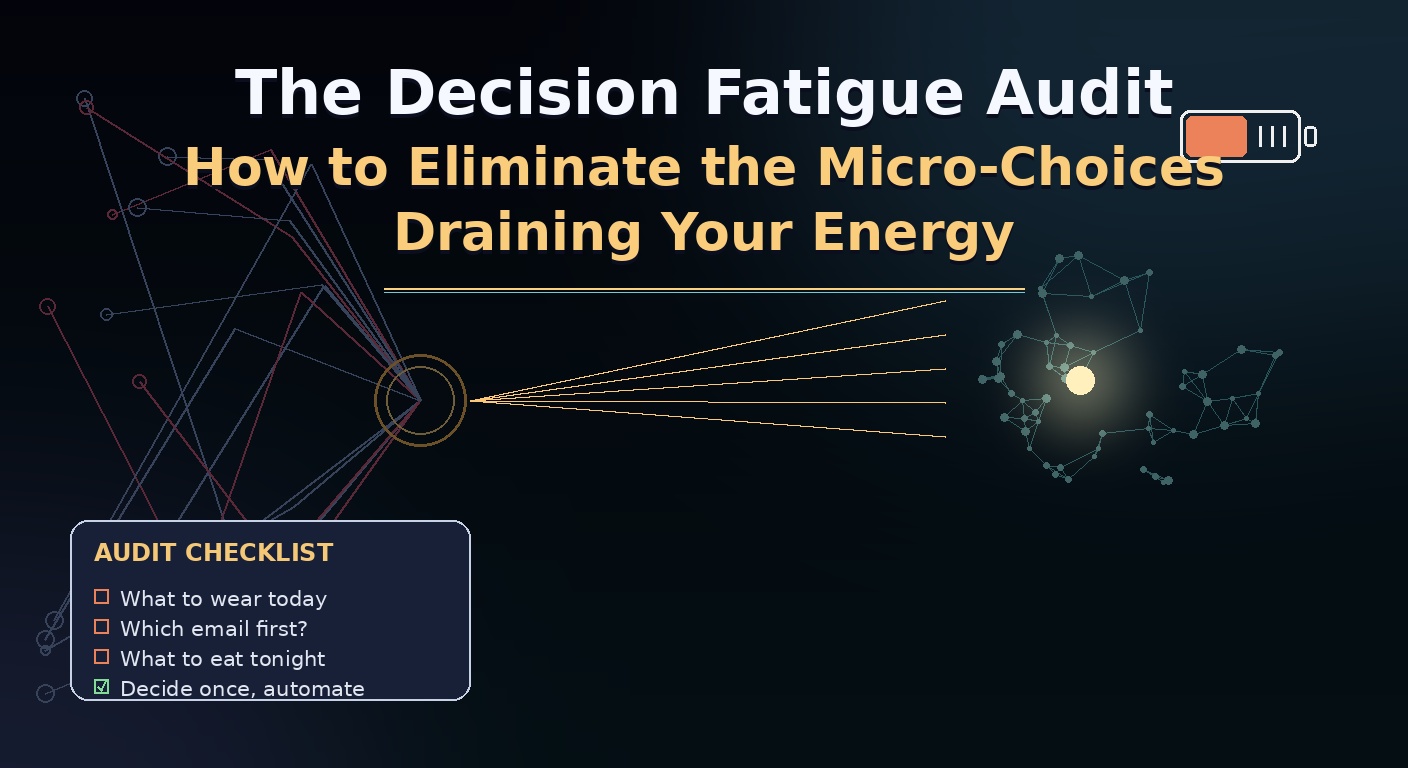
 You stare at your email inbox, unable to decide how to phrase a simple reply. You stand in the grocery store aisle, paralyzed by fifteen different brands of olive oil. By the time you get home, the seemingly simple question of “What should we have for dinner?” feels like a mental assault, causing you to snap at your family or default to a mindless, expensive food-delivery app.
You are not lazy, and you are not burning out because you lack willpower. You are suffering from decision fatigue.
Every single day, the average adult makes roughly 35,000 choices. These range from massive career pivots to microscopic internal debates: Should I check my phone now? Should I use a comma or a period? Should I drink water or grab a coffee?
What most people do not realize is that your brain treats decision-making like a bank account. It has a finite daily balance of executive cognitive energy. Crucially, the brain does not differentiate between a high-stakes business decision and a trivial micro-choice. Every time you select, deliberate, or judge, you make a withdrawal. By mid-afternoon, your account is overdrawn.
This is the definitive guide to conducting a personal Decision Fatigue Audit—a systematic diagnostic framework designed to identify your hidden cognitive drains, automate your routine choices, and protect your mental energy for the things that truly move the needle in your life.
how to stop overthinking
decision fatigue symptoms
1. The Neurobiology of Exhaustion: The Ego Depletion Engine
To fix your energy leaks, you must first understand the biology of the choosing brain. Executive functions, logic, and impulse control live in the prefrontal cortex (PFC). The PFC is the most evolutionarily advanced part of your brain, but it is also the most resource-intensive.
The Resource Drain
When the prefrontal cortex is forced to make continuous, back-to-back choices, it consumes glucose at an accelerated rate. As glucose levels drop, the PFC physically tires. To save energy, your brain shifts control over to a more primitive, energy-efficient structure: the amygdala.
┌────────────────────────────────────────────────────────┐
│             THE DECISION FATIGUE SHIFT                 │
├────────────────────────────────────────────────────────┤
│ High Glucose ──► Prefrontal Cortex (Logic & Strategy)   │
│                                                        │
│                    [ 35,000 Choices ]                  │
│                                                        │
│ Low Glucose  ──► Amygdala (Impulse, Laziness, Rage)     │
└────────────────────────────────────────────────────────┘
When the amygdala takes over due to low energy reserves, your decision-making style changes in one of two ways:
-
- Impulsivity: You act recklessly, buy things you don’t need, or give in to immediate dopamine traps (like social media or junk food).
- Avoidance/Paralysis: You resist making any choices at all, defaulting to procrastination or the easiest status quo.
By running a Decision Fatigue Audit, you stop trying to push through this biological wall with raw willpower. Instead, you design a lifestyle that keeps the prefrontal cortex running smoothly.
mental burnout recovery
2. Phase 1: The Decision Fatigue Audit Framework
An audit requires a accurate accounting of where your mental assets are going. For the next 48 hours, you will track your choices. You can do this in a simple notes app or a physical notebook.
Every time you find yourself pausing to deliberate, look at your watch, or make a selection, categorize the choice into one of the following four Mental Load Quadrants.
                 THE MENTAL LOAD QUADRANTS

       High Impact                    High Impact
       Low Frequency                  High Frequency
    ┌──────────────────────────────┬──────────────────────────────┐
    │                              │                              │
    │      1. STRATEGIC            │      2. INERTIAL             │
    │  (Career moves, investing)   │ (Compounding daily habits)   │
    │                              │                              │
    ├──────────────────────────────┼──────────────────────────────┤
    │                              │                              │
    │      3. EMOTIONAL            │      4. MICRO-DRAINS         │
    │ (People pleasing, boundary)  │ (What to wear, what to eat)  │
    │                              │                              │
    └──────────────────────────────┴──────────────────────────────┘
       Low Impact                     Low Impact
       Low Frequency                  High Frequency
Quadrant 1: Strategic Choices (High Impact, Low Frequency)
These are major, life-altering choices. Examples include changing your career path, buying a house, or reallocating your investment portfolio. These should consume your cognitive energy.
Quadrant 2: Inertial Choices (High Impact, High Frequency)
These are daily choices that build momentum. Examples include choosing to work out, choosing to sit down to write, or choosing to sleep on time. They have massive compounding power over long periods.
Quadrant 3: Emotional Choices (Low Impact, Low Frequency)
These are reactive choices driven by a lack of personal boundaries. Examples include debating how to politely decline an unwanted social invitation, or re-reading a text message five times before sending it to avoid conflict.
Quadrant 4: Micro-Drains (Low Impact, High Frequency)
This is where your daily energy leaks occur. Micro-drains are small, repetitive, low-stakes choices that you make every hour. Examples include deciding what to wear in the morning, scrolling through Netflix looking for a movie, or choosing which email to reply to first.
executive dysfunction hacks
3. Phase 2: Eliminating the Micro-Drains (The Automation Protocol)
The primary goal of the audit is to completely eliminate Quadrant 4 (Micro-Drains) so you can allocate that freed-up energy to Quadrant 1 and Quadrant 2. You achieve this by building clear, unyielding systems.
The Steve Jobs Uniform Method (Visual Autonomy)
The average person spends 7 to 15 minutes a morning deciding what to wear. This involves evaluating the weather, coordinating colors, and adjusting for comfort—draining your prefrontal cortex before you even leave the house.
-
- The Fix: Implement a strict Capsule Wardrobe. Select a fixed color palette (e.g., black, navy, grey, and white). Buy multiples of the exact same shirts, pants, and socks. Eliminate all choices from your morning dressing routine. Your outfit becomes static infrastructure, not a daily variable.
Dietary Scripting (Nutritional Autonomy)
“What should I eat?” is one of the most mentally exhausting choices we make, occurring up to three or four times every day.
-
- The Fix: Script your meals Monday through Friday. Eat the exact same breakfast and lunch every single working day. For dinner, assign fixed thematic choices to specific days (e.g., Monday is chicken and rice, Tuesday is pasta, Wednesday is salad). Save culinary experimentation exclusively for weekends when your cognitive load is low.
The Friction-Free Digital Desktop
Opening your computer to a cluttered desktop filled with open tabs and randomized files forcing you to think, “Where was I? What should I click first?” is an immediate energy leak.
-
- The Fix: Build a Single-Tab Workflow. Close every browser tab at the end of the work day. Use an app like OneTab or Session Buddy to save open windows. When you open your laptop the next morning, only allow the absolute primary task of the day to sit open on your screen.
4. Phase 3: Mitigating Inertial and Emotional Friction
Once your Micro-Drains are automated, you must fix the remaining leaks in Quadrant 2 and Quadrant 3 using pre-set boundaries.
Implementation Intentions (Fixing Inertial Drift)
When you rely on real-time decisions to build healthy habits, you will fail whenever you are tired. Asking yourself at 6:00 PM, “Should I go to the gym now?” allows decision fatigue to choose comfort over long-term growth.
-
- The Fix: Use the formula “If X, then Y.” Hardcode these rules into your brain ahead of time.
-
- Example: “If it is 6:00 PM on Tuesday, then I immediately change into my gym clothes without sitting on the couch.”
- Example: “If I open an email, then I must archive it, delete it, or reply to it immediately. I cannot close it to ‘think about it later’.”
-
- The Fix: Use the formula “If X, then Y.” Hardcode these rules into your brain ahead of time.
The 24-Hour Boundary Rule (Fixing Emotional Leaks)
People-pleasing drains cognitive energy because your brain spends hours running mental simulations of how others will react to your boundaries.
-
- The Fix: Introduce an automated buffer phrase for all unexpected invitations, requests, or demands on your time.
-
- Use this exact script: “Thank you for thinking of me. I review my schedule every Friday morning, so I will get back to you then.”
- This delays the choice, completely stopping impulsive, over-committed agreements while saving your brain from real-time anxiety.
-
- The Fix: Introduce an automated buffer phrase for all unexpected invitations, requests, or demands on your time.
capsule wardrobe productivity
5. Phase 4: Restructuring Your Daily Choice Architecture
To get the absolute most out of your prefrontal cortex, you must match your most difficult decisions to your brain’s natural energy peaks. This is called Choice Architecture.
The Maker’s Morning
Do not make a single strategic choice during the first 90 minutes of your workday.
-
- The Protocol: Determine your primary, most complex creative or analytical task the night before. Write it down on a physical index card. When you sit down at your desk in the morning, do not check Slack, do not open emails, and do not attend meetings. Go straight into that single task.
The Administrative Afternoon
Save your low-stakes, routine choices for after 2:00 PM.
-
- The Protocol: Use your low-energy window to process expense reports, book flights, organize files, and reply to routine messages. Because these tasks do not require deep strategic calculations, you can cruise through them comfortably even when your prefrontal cortex is low on glucose.
Conclusion: Reclaim Your Cognitive Liberty
Willpower is a finite resource. If you waste it on trivial, everyday choices, you will have nothing left when life demands real strategy, resilience, and creativity.
By conducting a Decision Fatigue Audit, you systematically strip away the noise. You turn your everyday routines into automated background scripts, allowing your mind to rest, focus, and create at its absolute highest potential. Stop choosing what doesn’t matter, so you can focus entirely on what does.